
1956-1965: A Decade of Scale, Efficiency and Change
A Look Back as ProAg Marks 100 Years, For Generations
 By 1956, American agriculture was entering a period of rapid change. Farms were growing larger and equipment was becoming more powerful. Production continued to increase, but so did pressure on margins and efficiency. The country was also undergoing broader change driven by global tension, technological advancement and shifting social dynamics.
This decade was defined by scale and efficiency. Farmers produced more with fewer people as technology improved yields. At the same time, agriculture faced new challenges tied to supply, pricing and long-term sustainability.
Crop Insurance History, 1956-1965
The Federal crop insurance continued to face challenges during this period. Participation remained limited, and the program struggled to expand beyond a narrow set of crops. Many farmers continued to rely on private risk management tools, including crop hail insurance.
This decade did not bring major expansion to federal crop insurance. Instead, it reinforced a key reality. For broader adoption to occur, the program would need to embrace the modern tenets of improved coverage, accessibility and affordability.
What Everyday Life Cost – 1956 Compared to 1965
The postwar economy continued to grow, with steady increases in income and consumer costs.
| Purchased Item | 1956 Price | 1956 Price (Today’s $) | 1965 Price | 1965 Price (Today’s $) |
| Gasoline (per gallon) | ~$0.30 | ~$3.30 | ~$0.31 | ~$3.00 |
| Milk (per gallon) | ~$0.93 | ~$10.30 | ~$1.06 | ~$9.90 |
| Eggs (per dozen) | ~$0.60 | ~$6.60 | ~$0.53 | ~$5.00 |
| Average New Car Price | ~$2,000 | ~$22,000 | ~$2,650 | ~$24,800 |
| Median Home Value | ~$11,700 | ~$129,000 | ~$13,600 | ~$127,000 |
As production increased, managing costs became just as important as increasing output on the farm, and across the nation.
Presidents and National Leadership During the Decade
Three presidents led the country during a period of economic growth and global tension. Their agricultural impact during this period included.
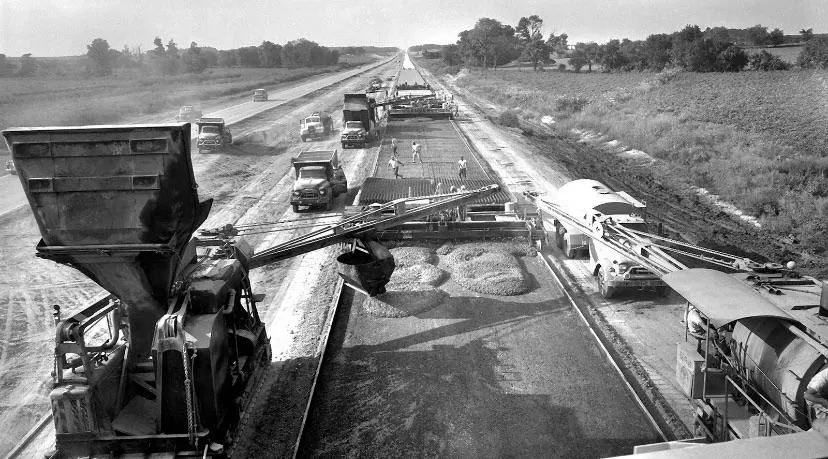
- Dwight D. Eisenhower (1953–1961) advanced national infrastructure through the Interstate Highway System, improving the movement of agricultural goods across the country. His administration also maintained price-support programs while managing surplus production and farm income stability.
- John F. Kennedy (1961–1963) focused on strengthening farm income through supply management and price support adjustments. His administration addressed ongoing surplus challenges and worked to improve the balance between production and demand.
- Lyndon B. Johnson (1963–1969) expanded domestic programs through the Great Society, including food assistance and rural development initiatives. These programs increased demand for agricultural products and strengthened the connection between farm policy and national food programs
Defining American Events, 1956–1965
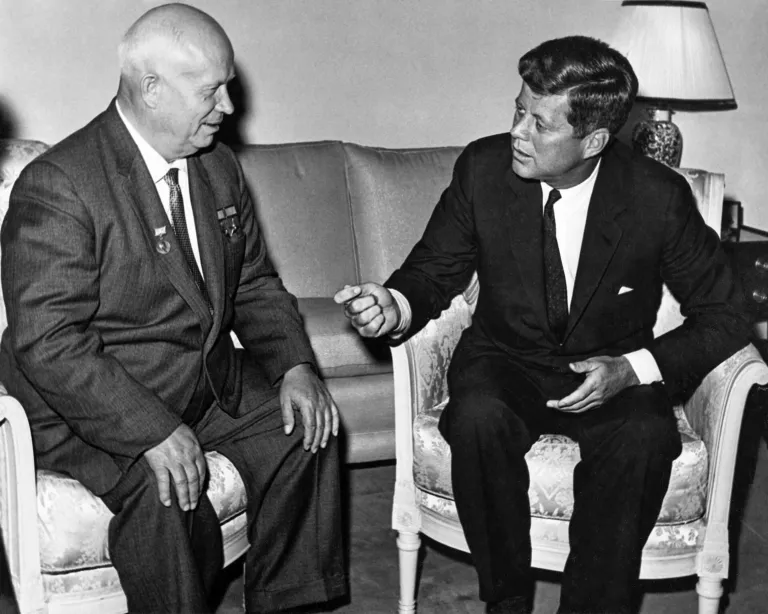
President John F. Kennedy meeting with Soviet Premier Nikita Khrushchev in Vienna in June 1961
This decade brought structural and cultural change across the country.
- In 1956, the 41,000-mile Interstate Highway System was constructed, transforming the national distribution of agricultural products and the economy
- October 1958 saw the first commercial passenger jet aircraft fly, changing transportation in the US almost immediately
- Population growth increased demand for food and consumer goods
- Suburban expansion continued, shifting land use and rural demographics
- The Cold War influenced trade, policy and global markets
- The Cold War intensified, shaping global trade, policy and agricultural markets
- The Space Race began with the launch of Sputnik in 1957, accelerating technological advancement
- The Berlin Wall was constructed in 1961, reflecting deep geopolitical division
- The Cuban Missile Crisis in 1962 brought global tensions to a peak
- President John F. Kennedy was assassinated in 1963, marking a defining national moment
- U.S. involvement in Vietnam escalated through the early 1960s
- The landmark Civil Rights Act of 1964 was passed by Congress, defining much of the cultural and structural change for the following decades
Federal agricultural policy also focused on managing supply and stabilizing farm income.
- The Soil Bank Act of 1956 paid farmers to remove land from production to reduce surplus
- The Agricultural Act of 1961 introduced stronger supply controls for major crops
- The Food and Agriculture Act of 1965 continued price supports and expanded food programs
Agriculture Answers the Call
American agriculture continued to evolve toward larger, more efficient operations. But while the farms increased in size while the number of farms declined. Mechanization reduced labor needs and increased output per acre.
Key developments during this period included:
- Wider adoption of hybrid seeds, especially in corn production
- Increased use of chemical fertilizers to improve yields
- Growth in herbicides and crop protection products
- Continued expansion of irrigation in key regions
- More powerful tractors and equipment across all major crops
These advancements allowed farmers to produce more with fewer resources but also increased reliance on inputs and capital.
Surplus production remained a challenge. Government programs worked to manage supply and support prices, while farmers focused on efficiency to remain competitive.
This decade reinforced a clear shift – agriculture was no longer defined by labor alone. It was defined by productivity, scale and the ability to manage risk in a more complex system.