
1986-1995: A Decade of Recovery, Reform and New Tools
A Look Back as ProAg Marks 100 Years, For Generations

By 1986, American agriculture was still working through the damage left by the farm crisis. Debt, lower land values and tighter credit continued to affect many farm families and rural communities. Recovery was underway, but it did not come quickly or evenly.
The next 10 years tested agriculture in different ways. Weather disasters continued to test producers, crop insurance participation remained lower than Congress desired and new technology was beginning to move into farm management. By the middle of the 1990s, producers had new management tools, more useful field-level data and a crop insurance program redesigned to reach more farmers before the next disaster hit.
Crop Insurance and ProAg History, 1986-1995
For ProAg’s business, this period was part of a larger expansion that had begun in the years of the Producers Lloyds Insurance Company. Jess Benjamin “Benny” Latham III, along with his father and brother, Larry Latham, helped expand the company into 40 states with more than 350 employees. That growth came as federal crop insurance was moving toward broader coverage and a larger role for private-sector delivery.
 The Federal Crop Insurance Act of 1980 expanded coverage and brought private companies into the policy delivery process, but participation still did not reach the level Congress had hoped for. When a major drought hit in 1988, many producers remained uninsured or underinsured, and Congress authorized ad hoc disaster assistance. Another disaster bill followed in 1989. A third came in 1992, and more assistance followed after the extremely wet and cool 1993 growing season.
Together, those repeated ad hoc disaster bills pushed Congress toward reform.
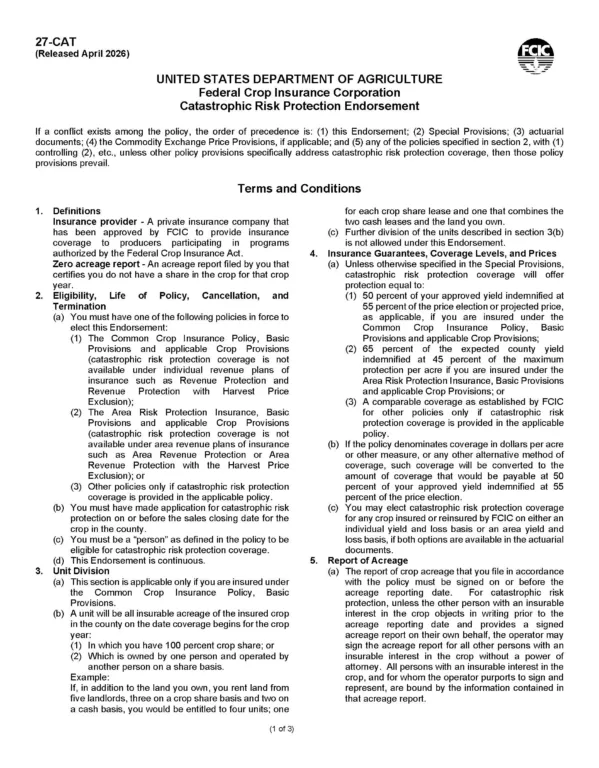
In 1994, Congress passed the Federal Crop Insurance Reform Act. The law made participation in crop insurance mandatory for farmers to be eligible for certain USDA benefits, including deficiency payments, price support programs and some loans. To support that requirement, the law created Catastrophic (CAT) coverage. CAT coverage was established to pay 60% of the commodity price set by RMA (now 55% of the established price) for crop losses exceeding 50% of the policy’s Actual Production History (APH). The Federal government subsidizes 100% of the premium, but an administrative fee must be paid for each crop insured in each county. The act also increased subsidies for higher levels of coverage.
The 1994 Reform Act changed the program’s direction, even though more work remained to build the modern crop insurance system. The focus shifted toward getting more producers insured before losses occurred, rather than relying on disaster bills after the damage was done.
What Everyday Life Cost – 1986 Compared to 1995
Prices continued to rise through this decade, but inflation had cooled from the sharp increases of the late 1970s and early 1980s.
| Purchased Item | 1986 Price | 1986 Price (Today’s $) | 1995 Price | 1995 Price (Today’s $) |
| Gasoline (per gallon) | ~$0.93 | ~$2.70 | ~$1.15 | ~$2.40 |
| Milk (per gallon) | ~$2.03 | ~$5.95 | ~$2.48 | ~$5.25 |
| Eggs (per dozen) | ~$0.87 | ~$2.55 | ~$0.92 | ~$1/95 |
| Average New Car Price | ~$10,400 | ~$30,700 | ~$19,750 | ~$41,700 |
| Median Home Value | ~$92,000 | ~$270,000 | ~$133,500 | ~$282,000 |
For farm families, grocery, fuel and housing costs told only part of the story. The larger financial questions were tied to land values, operating loans, commodity prices and the ability to recover from weather losses.
Presidents and National Leadership During the Decade

Yitzhak Rabin, Clinton and Yasser Arafat during the Oslo Accords on September 13, 1993
Three different presidents led the country as agriculture worked through recovery from the farm crisis, the Cold War came to an end and crop insurance drew renewed attention.
- Ronald Reagan (1981–1989) served through the final years of the farm crisis and the 1988 drought. His administration also dealt with farm credit pressure as rural lenders and producers continued working through the financial strain of the early 1980s.
- George H.W. Bush (1989–1993) signed the 1990 Farm Bill, which guided commodity, conservation, credit, trade and food programs from 1991 through 1995. His presidency also included the end of the Cold War, the Gulf War and continued changes in global trade.
- Bill Clinton (1993–2001) took office as major flooding and crop losses hit the Midwest. His administration signed the 1994 Federal Crop Insurance Reform Act, which changed crop insurance participation and created CAT coverage.
Defining American Events, 1986–1995
This decade brought events that many Americans still remember.
- The Space Shuttle Challenger disaster occurred in 1986.
- The stock market fell sharply on Black Monday in 1987.
- The Exxon Valdez oil spill occurred in Alaska in 1989.
- The Berlin Wall began coming down in 1989, followed by the collapse of the Soviet Union in 1991.
- The Americans with Disabilities Act was signed into law in 1990.
- The Gulf War took place in 1990 and 1991.
- Civil unrest in Los Angeles followed the Rodney King verdict in 1992.
- The World Wide Web began moving into public use during the early 1990s.
- NAFTA, the North American Free Trade Agreement, entered into force on Jan. 1, 1994, changing trade relationships between the United States, Canada and Mexico.
- The Oklahoma City bombing occurred in 1995.
Federal agricultural policy also changed during this period.
- The Agricultural Credit Act of 1987 responded to financial stress in the Farm Credit System and farm lending.
- Disaster assistance followed the major drought of 1988 and additional losses in 1989, 1992 and 1993.
- The Food, Agriculture, Conservation and Trade Act of 1990 provided the farm program framework for 1991 through 1995.
- The Federal Crop Insurance Reform Act of 1994 restructured crop insurance, created CAT coverage and increased subsidies for higher coverage levels.
Agriculture Rebuilds While Weather Tests the System
 While the 1980–1982 recession ended, the intertwined farm crisis did not end on any single date. Many producers spent the late 1980s rebuilding equity, paying down debt and making more cautious decisions about borrowing. Rural banks and agricultural businesses were also adjusting to a different financial reality.
The weather kept testing the system. The 1988 drought caused widespread losses and led to disaster assistance for eligible farmers. In 1993, heavy rain and flooding across the Midwest caused additional crop damage and prompted another round of federal relief.
These events exposed the same problem again and again. When too many producers went without meaningful coverage, Congress was left to respond after the loss with ad hoc disaster payments. The approach was expensive, uncertain and often slow for farm families who needed help quickly.
New technology was also beginning to change how farmers understood their fields. Early yield monitors, paired with GPS mapping, helped connect harvest results to specific locations rather than relying solely on whole-field averages. Over time, that information helped producers compare lower-yielding areas with soil type, drainage, fertility, seed placement and input decisions. The technology was still early, but it pointed toward the precision agriculture systems that would become more common in the decades ahead.
Biotechnology was moving closer to the farm as well. In 1994, the FDA approved the FLAVR SAVR tomato, the first genetically engineered food approved for sale in the United States. Major adoption of genetically engineered field crops would begin just after this decade, but the groundwork was already being laid.
A Turning Point for Crop Insurance Participation
The Federal Crop Insurance Reform Act of 1994 became the defining crop insurance event of this decade because it addressed a pattern that had become familiar. Drought, flooding and crop losses were followed by ad hoc disaster bills, leaving producers, agents and Congress to deal with losses after the damage was already done.
The law changed how the program worked. It created catastrophic coverage, known as CAT, increased subsidies for higher coverage levels and tied crop insurance participation to eligibility for certain USDA benefits. The goal was to make coverage more accessible and move crop insurance into a stronger role in farm planning.
For ProAg’s 100-year story, that reform marked an important shift. Crop insurance was moving into a more practical role in annual farm planning and risk management. More changes would come in the years ahead, but by the end of 1995, the direction was clear. Farmers needed dependable protection in place before the season tested them, and agents and Approved Insurance Providers would play a larger role in helping deliver it for generations to come.