
Enhanced Coverage Option (ECO)

The Enhanced Coverage Option (ECO) insurance policy option provides area-based coverage for a portion of the underlying crop insurance policy deductible.


The premium cost is shared between you and the government, where the government pays 80 percent of the premium for yield and revenue policies

Offers up to 95% coverage, the highest subsidized MPCI coverage available

County-based, which benefits farmers whose yield and revenue correlate with the county

Supplemental shallow-loss coverage
Overview of Enhanced Coverage Option (ECO) Insurance Option:
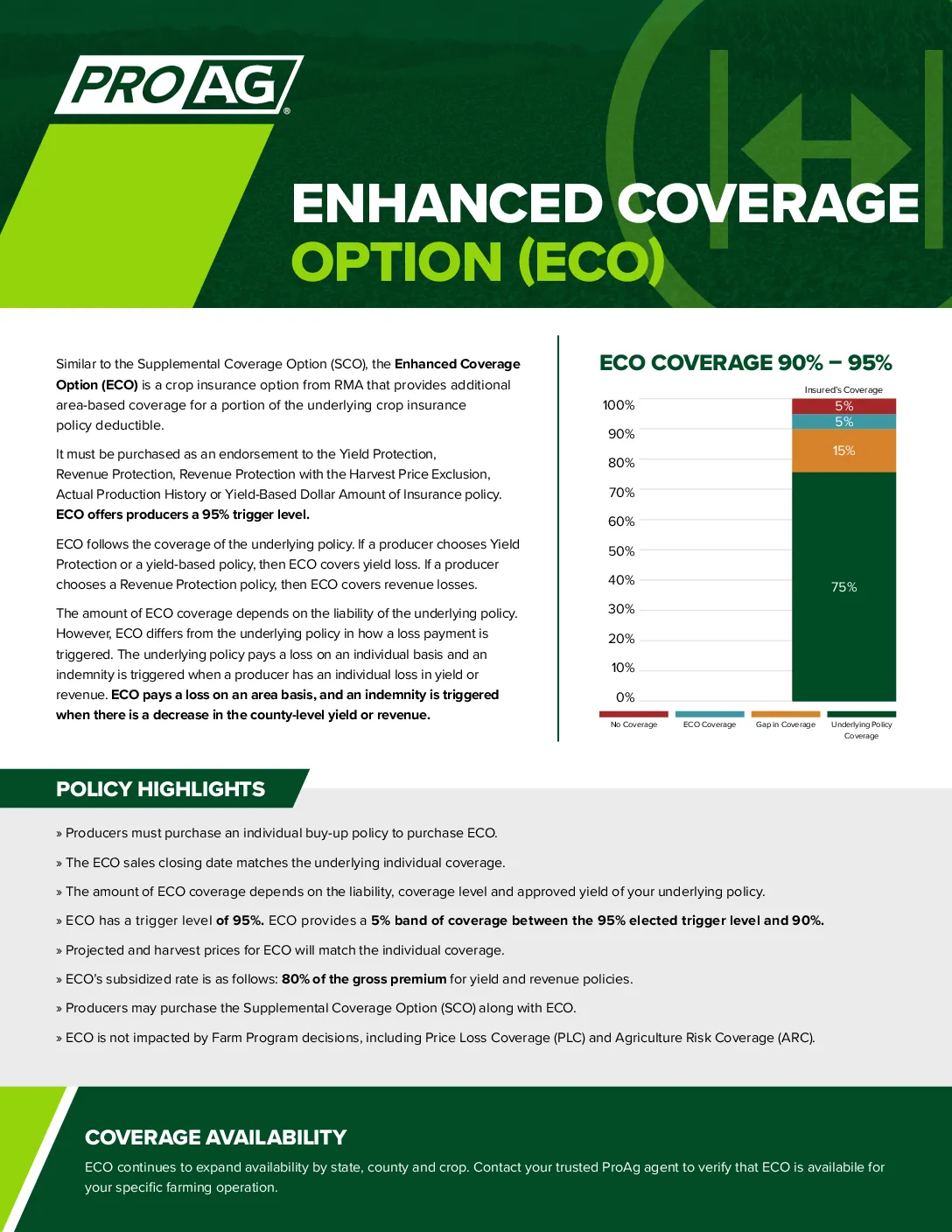
Similar to the Supplemental Coverage Option (SCO), the Enhanced Coverage Option (ECO) is a crop insurance policy option that provides additional area-based coverage for a portion of the underlying crop insurance policy deductible.
It must be purchased as an endorsement to the Yield Protection, Revenue Protection, Revenue Protection with the Harvest Price Exclusion, Actual Production History or Yield Based Dollar Amount of Insurance policy. ECO offers producers a 95% trigger levels. The term “trigger” refers to the percentage of expected yield or revenue at which a loss becomes payable.
How Does the ECO Insurance Option Work?
ECO follows the coverage of the underlying policy. If a producer chooses Yield Protection or a yield-based policy, then ECO covers yield loss. If a producer chooses a Revenue Protection policy, then ECO covers revenue losses.
The amount of ECO coverage depends on the liability of the underlying policy. However, ECO differs from the underlying policy in how a loss payment is triggered. The underlying policy pays a loss on an individual basis and an indemnity is triggered when a producer has an individual loss in yield or revenue. ECO pays a loss on an area basis, and an indemnity is triggered when there is a decrease in the county-level yield or revenue.
ECO has a trigger level of 95%. ECO provides a 5% band of coverage between the 95% elected trigger level and 90%. If the county yield or revenue is reduced beyond the trigger level, the producer will receive an ECO indemnity.
Quick ECO Endorsement Facts
- ECO sales closing date matches the underlying individual coverage.
- Separate premium and administrative fees for ECO by crop/county.
- ECO’s subsidized rate is 80%
- Producers may purchase the Supplemental Coverage Option (SCO) along with ECO.
- Producers are not required to purchase SCO. They can leave a gap in coverage.
- ECO is not impacted by Farm Program decisions, including Price Loss Coverage (PLC) and Agriculture Risk Coverage (ARC).
- If a producer buys ECO, the producer may not:
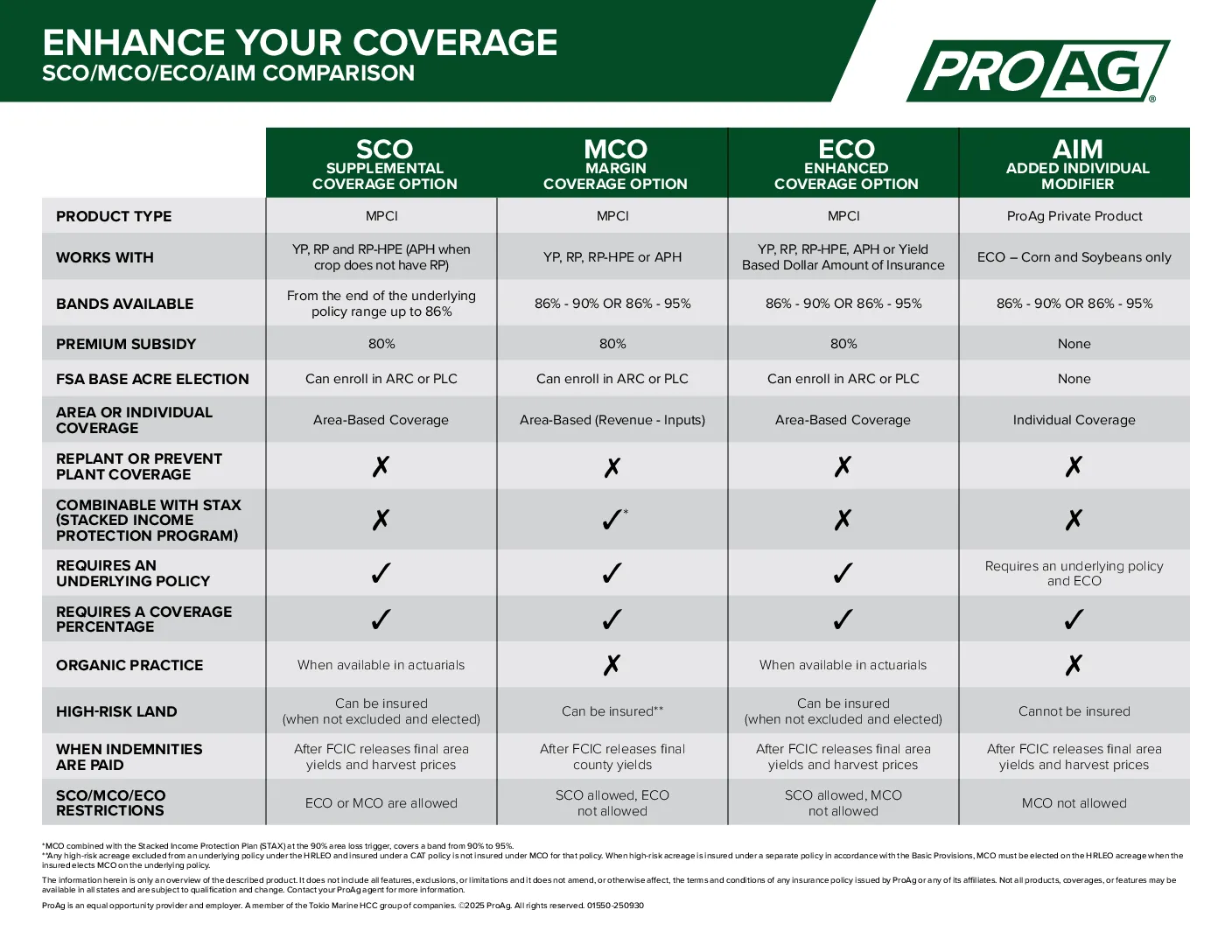
- Purchase Margin Protection (MP), Margin Protection with the Harvest Price Option (MP-HPO), Area Revenue Protection Insurance (ARPI), Hurricane Insurance Protection Wind Index (HIP-WI), Margin Coverage Option (MCO) or other area plans.
ECO Availability:
ECO is available for the crops below in most counties where these crops are grown. Additional crops will be added in subsequent years based on producer interest and data availability.
- Alfalfa Seed
- Almonds
- Apples
- Barley
- Blueberries
- Buckwheat
- Burley Tobacco
- Canola
- Cigar Binder Tobacco
- Citrus
- Corn
- Cotton – including Ex. Long Staple
- Cultivated Wild Rice
- Dark Air Tobacco
- Dry Beans
- Dry Peas
- Fire Cured Tobacco
- Flax
- Flue Cured Tobacco
- Forage Production
- Grain Sorghum
- Grapes
- Grass Seed
- Hybrid Corn Seed
- Hybrid Seed Rice
- Hybrid Sorghum Seed
- Millet
- Oats
- Peanuts
- Popcorn
- Rice
- Rye
- Safflower
- Sesame
- Silage Sorghum
- Soybeans
- Sugar Beets
- Sugarcane
- Sunflowers
- Walnuts
- Wheat
Coverage Example
A producer’s corn crop has an expected value of $765.00 per acre (170 bushels at $4.50 per bushel). A Revenue Protection policy with a 75% coverage level is purchased. This is the ‘underlying policy.’ The underlying policy covers 75% (or $573.75) of the expected crop value and leaves 25% (or $191.25) uncovered as a deductible.
At this point, the producer has the option to buy ECO coverage. Since the underlying policy is Revenue Protection, ECO will also provide revenue protection, except ECO’s payments will be determined at a county level. The ECO revenue coverage is described in the following table. ECO yield coverage performs in the same manner.
ECO Coverage Calculation for 95% Area Trigger Level
 ECO Endorsement begins to pay when the county revenue falls below this percent of its expected level
- 95%
- ECO Endorsement pays out its full amount when the county revenue falls to 86 percent of its expected level
- 90%
- Percent of expected crop value covered by ECO (Value 1 – Value 2)
- 95% – 90% = 5%
- Amount of ECO Protection (Percent of Expected Crop Value Covered by ECO x Expected Crop Value)
- 5% X $765.00 = $38.25
The ECO Endorsement begins to pay when the county average yield or revenue falls below 95% of its expected level. The full amount of the ECO coverage is paid out when the county average revenue falls to 90%.
ECO insurance payments are determined only by county average revenue or yield and are not affected if the producer receives a payment from the underlying policy. Therefore, it is possible for a producer to experience an individual loss but not receive an ECO payment, or vice-versa. A producer may also receive a loss on both the underlying policy and ECO.
The dollar amount of ECO coverage is based on the percent of crop value covered. In this example, there are five percentage points of coverage – from 95% to 90%. Five percent of the expected crop value ($765.00) is $38.25 (5% x $765.00). Thus, the ECO policy can cover up to $38.25 of the $191.25 deductible amount not covered by the underlying policy. A producer may cover a portion of the remaining amount of the deductible with other coverage, such as the Supplemental Coverage Option (SCO).
Indemnity Overview
- ECO expected and final yields are based on RMA data, NOT producer yields.
- ECO indemnities will be paid in the summer following the crop year, NOT at harvest time.
- ECO and individual coverage trigger independently. It is possible for a grower to have:
- An ECO indemnity, but no individual indemnity
- An individual indemnity, but no ECO indemnity
- Indemnities from both programs
- No indemnities
ECO on a Revenue Protection policy example*:
The expected area yield is 200 bu./acre and the projected price is $4.00/bu. The expected area revenue is $800.00 per acre. The coverage range is the selected ECO coverage level 95% – 90% = 5%. The producer has an approved yield of 210 bu./acre and purchased the 70% coverage level for the underlying revenue protection policy. The producer will be planting 1,000 acres at 100% share.
With this information, the liability of the underlying policy is 210 bu/acre x 0.70 x $4.00/bu x 1,000 acres x 1.000 share = $588,000. The expected crop value = $588,000 / 0.70 = $840,000. And the ECO protection is $840,000 x 0.05 x 0.80 = $33,600.
At the end of the insurance period, FCIC release the following information. The harvest price is $3.90/bu. and the final area yield is 190 bu./acre. The final area revenue is $741.00 per acre.
Indemnity Calculation:
The expected area revenue (from the actuarial documents) remains at $800.00 per acre (harvest price < projected price).
Take the final area revenue ($741.00/acre) and divide it by the expected area revenue ($800.00/acre) to come up an area loss trigger of 0.9263. Subtract the area loss trigger from 95% to get 0.0237. The result is positive, so the percent of loss is 0.4740. (Using the formula of Min(0.0237 / 0.0500, 1.0000))
The harvest price is less than the projected price, so the ECO protection remains at $33,600.
The indemnity is $33,600 X 0.4740 = $15,926.
*Yields and prices are for illustration purposes only.





Find a ProAg Agent
Pro Ag Management, Inc.* (collectively with its corporate affiliates, “ProAg®”) is a managing general agency representing several risk bearing insurance companies, including Producers Agriculture Insurance Company and U.S. Specialty Insurance Company and doing business as Pro Ag Insurance Services, Inc. in California, CA Entity License #0F34212. The insurance products described on this website may not be a complete list of all products offered and may not be offered in all states. The provided information does not amend, or otherwise affect, the terms and conditions of any insurance policy issued by ProAg or any of its subsidiaries; always refer to the policy provisions. Actual coverages will vary based on the terms and conditions of the policy issued.